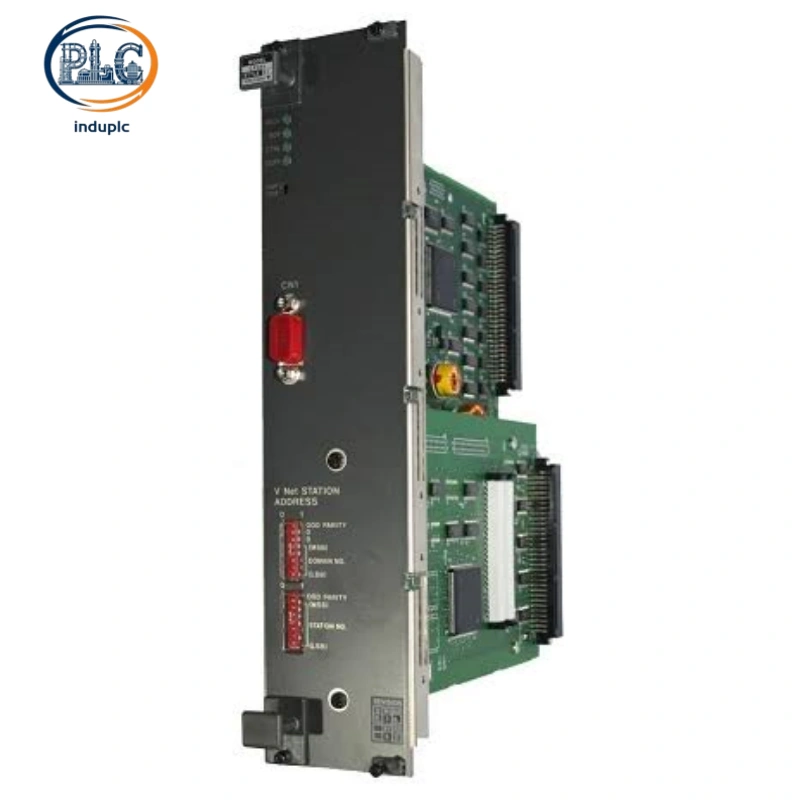
Yokogawa CP345 Control Processor Module, Dual-Redundant High-Speed CPU Unit for CENTUM VP/CS3000 DCS Main Control Operation
Product Description
Yokogawa CP345 Control Processor Module, Dual-Redundant High-Speed CPU Unit for CENTUM VP/CS3000 DCS Main Control Operation
Yokogawa CP345 High-Reliability Dual-Redundant Control Processor Module for CENTUM Series DCS Core Operation
1. DCS Core Processor & High-Speed Computing Performance
The CP345 acts as the central processing core of CENTUM DCS field control stations, undertaking all core tasks including process logic calculation, interlock judgment, I/O data scheduling and system operation management. Equipped with industrial multi-core high-speed processor and large-capacity onboard memory, it supports stable operation of complex control algorithms, batch sequence logic and massive point data processing without computation delay or program overflow.
Different from ordinary I/O and communication modules, this processor unit determines the overall real-time performance and operational stability of the DCS control station. It maintains fixed high-cycle scanning efficiency to ensure synchronized and accurate execution of field control logic for 24/7 continuous production.
2. Dual Redundant Fault-Tolerant Architecture
Built for high-reliability industrial scenarios, CP345 supports full dual-redundant hot-standby deployment. The active and standby CPU units perform real-time data synchronization and logic mirroring. Once the main processor fails, the standby module achieves bumpless automatic takeover in milliseconds, completely avoiding system downtime, control interruption or production halt caused by single-point CPU failure.
The fault self-diagnosis mechanism continuously monitors processor operating status, bus communication and data operation exceptions. It automatically alarms and isolates abnormal states, greatly improving the overall fault tolerance and safety level of the DCS control system.
3. Multi-Protocol Integrated Network Communication
CP345 integrates rich industrial communication interfaces and mainstream protocols, including Vnet/IP dedicated DCS bus, standard Ethernet and Modbus/TCP. It supports seamless data interaction between upper monitoring stations, lower-layer FIO/N-IO I/O racks and third-party field devices, realizing unified scheduling of internal system data and cross-device transparent transmission.
With efficient bus data processing capability, the module supports large-scale node network management and high-frequency data exchange. It ensures stable connection of distributed I/O, PROFIBUS devices and auxiliary control subsystems, adapting to complex network topology of large process plants.
4. Ultra-Wide Industrial Environmental Adaptability
Designed for harsh industrial environments, CP345 features an ultra-wide operating temperature range of -20°C to +70°C, far exceeding ordinary I/O modules. It stably copes with extreme temperature fluctuations in outdoor cabinets, heat-intensive workshops and long-term unattended equipment rooms.
The module tolerates 5%–95% non-condensing industrial humidity and passes strict industrial vibration and aging tests. Reinforced hardware structure and industrial-grade components ensure long-term stable core operation, reducing failure rate of key control units.
5. System Compatibility & Industrial Core Advantages
Application Scenarios: Widely deployed in petrochemical, thermal power, chemical and pharmaceutical industries as the core CPU of CENTUM VP and CS3000 DCS control stations. It is applicable for main process loop control, safety interlock system operation, large-scale I/O scheduling and continuous production process core computing scenarios.
Core Competitive Advantages: Professional DCS dedicated processor ensures accurate and low-latency logic operation; dual redundant bumpless switching guarantees zero downtime for key production lines; multi-protocol integration simplifies system network architecture; ultra-wide temperature design adapts to harsh industrial conditions; full compatibility with classic and new-generation CENTUM platforms supports system upgrade and stable inheritance.