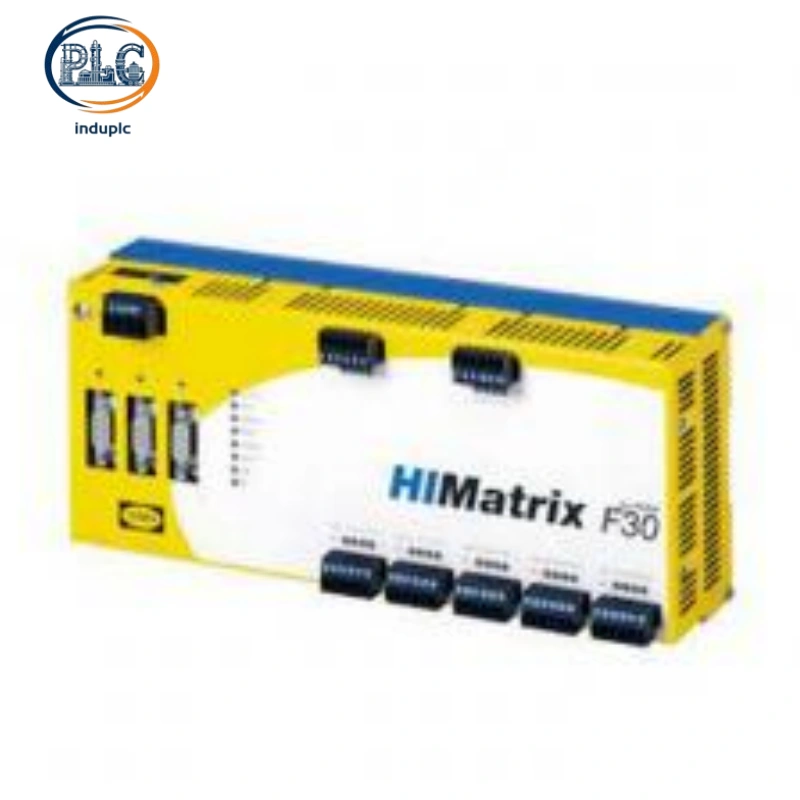
HIMA HIMatrix‑F30 Compact Lock‑Step Safety Logic Controller For Small‑Scale Field‑Side Safety Loops
Product Description
HIMA HIMatrix‑F30 Compact Lock‑Step Safety Logic Controller For Small‑Scale Field‑Side Safety Loops
1. Hardware Architecture And Redundancy Execution Mechanism
Rather than separate rack‑based CPU and detachable I/O boards, the HIMatrix F30 is an all‑in‑one compact safety controller built with metal‑shielded casing, designed for DIN‑rail installation close to field‑level equipment. Its onboard hardware integrates 20 digital‑input channels and eight transistor‑type safety‑output terminals, removing the necessity for initial I‑O expansion when deploying modest‑size emergency‑stop and interlock circuits.
The core safety processing unit uses dual‑core lock‑step operating architecture. Two identical processing cores run safety logic programs simultaneously, continuously comparing operation outcomes after every scan cycle. When calculation inconsistency, internal component failure, field‑wire short‑circuit or cable break‑off gets spotted, the controller instantly forces every safety‑related output into the de‑energized safe‑state and triggers the hardware fault‑warning lamp. Each input circuit carries out continuous cable diagnostics, detecting broken wiring and poor contact without auxiliary detection hardware. Two independent 24‑VDC power terminals enable dual‑source redundant power feeding. Built‑in 100 Mbps integrated Ethernet switch supports SafeEthernet safety‑bus communication, and the internal surge‑protection circuitry guards against voltage surges generated by nearby high‑power machinery. Multiple hardware editions are available, including low‑temperature‑adapted variants and versions suitable for hazardous Ex‑Zone‑2 installationManualsLib.
2. Supported Operating Platforms And Full Hardware Compatibility Inventory
HIMatrix‑F30 belongs to the lightweight branch of the HIMatrix safety‑controller family. It can be configured by two independent engineering software environments: ELOP‑II‑Factory for older‑style safety‑project editing and SILworX for modern‑day system diagnosis, event log analysis and distributed network debugging. It can interconnect with other F‑series controllers via SafeEthernet and form multi‑node distributed safety‑networks. The onboard Ethernet port supports Modbus‑TCP, PROFIBUS‑DP and other common industrial protocols for non‑safety data exchange with conventional DCS and third‑party PLC hardware. This compact controller cannot adapt to the old‑generation H41q rack system because of incompatible safety‑bus communication protocols.
Compatible peripheral accessories and field‑side equipment:
- Dual HIMA F7126 24‑volt direct‑current redundant power‑supply modules
- Spring‑type detachable terminal blocks for speedy field‑signal wiring
- F‑series expansion I/O cards, including analog‑signal acquisition modules and safety‑relay output adapters
- Field‑installed hardware: emergency‑stop buttons, safety‑door contacts, speed sensors and solenoid‑driven safety valves
- Industrial Ethernet cables for inter‑controller safety‑bus connection
The working power source must adopt isolated 24 V‑DC SELV power supply. Non‑isolated power supply equipment may trigger electromagnetic interference and compromise SIL‑3 safety performance.
3. Segmented‑industry Deployment Solutions And On‑site Working‑condition Pain‑point Handling
3.4 Packaging‑machine Safety Interlock Control
Packaging machinery features multiple moving rollers, cutter assemblies and feeding mechanisms. Common‑site troubles contain limited installation space on machine‑local control cabinets, frequent vibration during long‑time equipment operation and complicated wiring for scattered safety‑switches. The compact DIN‑rail mounted F30 can be fixed right inside narrow machine‑side cabinets. Its metal shell provides vibration‑shielding capability, and the twenty built‑in DI channels are sufficient for connecting all safety‑door switches, emergency‑stop buttons and grating‑sensor signals. Once operators open the protective cover, the lock‑step CPU immediately cuts off the drive‑related output and stops hazardous mechanical movement.
3.2 Small‑size Biochemical Workshop Emergency Shutdown System
Mini‑batch pharmaceutical and fine‑chemical workshops own several reaction kettles. Operators often encounter troubles including limited SIS cabinet layout space, explosive‑risk Zone‑2 installation requirements and frequent routine maintenance on interlock‑related sensors. F30 supports installation inside Ex‑Zone‑2 hazardous zones. Its integrated I/O design cuts down the quantity of separate modules and simplifies cabinet layout. Built‑in channel fault diagnosis helps maintenance‑staff quickly locate broken signal cables and faulty proximity switches without additional testing devices, shortening equipment‑checking time during batch‑production intervals.
3.3 Conveyor‑belt Safety Monitoring For Bulk‑material Logistics Sites
Mine‑run‑of‑mine and grain‑handling conveyor‑belt stations are faced with vibration, dust pollution, scattered pull‑wire emergency‑stop switches distributed over lengthy belts and high‑frequency signal switching. Thanks to its wide‑temperature hardware variant and strong EMC anti‑interference performance, F30 can endure dusty and vibrating working‑surroundings. Multiple controllers can be linked through SafeEthernet safety bus, realising coordinated interlock among multi‑segment conveyors. When one‑section belt pulls‑rope stop gets triggered, the system shuts down upstream transport equipment sequentially to prevent material stacking‑up accidents.