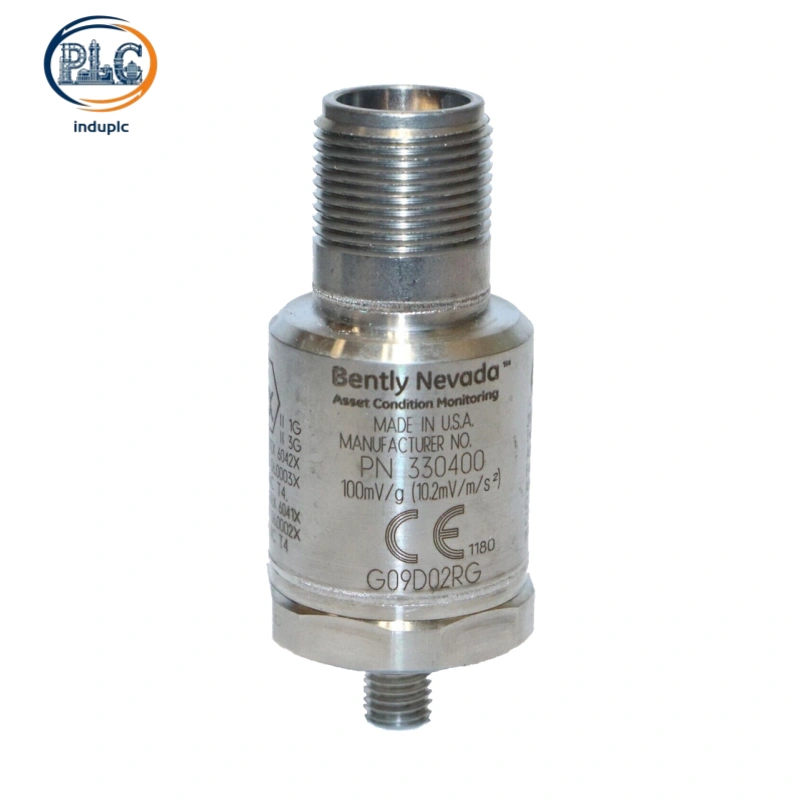
Bently Nevada 330400 | Industrial Accelerometer Vibration Transducer
Product Description
Bently Nevada 330400 | Industrial Accelerometer Vibration Transducer
Traditional eddy-current probes focus on shaft radial vibration monitoring, yet many industrial equipment faults such as casing looseness, structural resonance and base sway can hardly be captured by internal shaft detection alone. The Bently Nevada 330400 fills this monitoring gap as a professional industrial accelerometer tailored for surface vibration detection. Different from 3300 XL series proximity sensors that rely on eddy-current principles, this transducer adopts piezoelectric acceleration sensing technology, dedicated to collecting high-precision casing and structural vibration data of rotating machinery. Widely deployed in power generation, petrochemical and industrial processing facilities, it serves as a core supplement for comprehensive equipment condition monitoring, realizing full-dimensional fault early warning for large mechanical units.
Unique Product Positioning & Working Principle
The 330400 series represents Bently Nevada’s mature surface vibration monitoring solution, completely different from shaft displacement probes. It is installed on the outer casing, support base and structural parts of equipment, directly sensing mechanical vibration acceleration changes generated by equipment operation. Built with high-stability piezoelectric ceramic components, the sensor converts tiny mechanical vibration signals into standard analog voltage output through internal precision circuit conversion. It features excellent frequency response and linearity, which can accurately capture subtle vibration anomalies such as unbalance, misalignment, structural resonance and component looseness that are easily ignored by traditional shaft monitoring systems.
Core Technical Parameters
Product Model:330400 Industrial Accelerometer Transducer
Sensing Principle:Piezoelectric acceleration induction
Standard Sensitivity:100 mV/g, stable and consistent output for long-term monitoring
Peak Amplitude Range:50g peak, adapting to strong vibration working conditions of heavy-duty industrial equipment
Effective Frequency Response:Covers industrial conventional vibration frequency band, matching fault diagnosis requirements of rotating machinery
Overall Accuracy:Full-scale error ≤0.02%, ensuring high-precision data acquisition
Shell Material:Corrosion-resistant all-stainless steel sealed structure, dust-proof, oil-proof and anti-aging
Operating Temperature Range:-40℃ ~ +85℃, adapting to complex and harsh industrial site environments
Installation Method:Surface fixed mounting, suitable for equipment casing, support and base installation
Safety Certification:CSA, ATEX, IECEx hazardous area explosion-proof certification, applicable to flammable and explosive industrial scenarios
Model Differentiation & Series Features
The 330400 series includes two mainstream models with clear functional differentiation to meet different on-site vibration intensity monitoring needs. Compared with the 330425 high-amplitude version, the standard 330400 is more suitable for conventional medium and low vibration equipment monitoring scenarios. With 100mV/g high-sensitivity output, it can identify tiny vibration changes, making it the preferred model for precision monitoring of most steam turbines, compressors and auxiliary mechanical equipment. In contrast, the 330425 version is designed for high-vibration working conditions, with 75g peak range and 25mV/g low sensitivity, suitable for heavy-load equipment with severe vibration fluctuations.
Complete System Matching Scheme
As a surface vibration sensing device, the 330400 can form a complete multi-dimensional monitoring system with Bently Nevada’s mainstream monitoring modules, realizing integrated shaft and casing vibration monitoring:
-
Monitoring Module Adaptation:Perfectly compatible with 3500 series vibration monitoring modules, supporting real-time data acquisition and logic alarm output
-
Signal Transmission:Matched with dedicated industrial shielded cables to ensure low-noise and low-loss signal transmission on site
-
System Collocation:Used in conjunction with 3300 XL proximity probes to realize dual monitoring of internal shaft vibration and external casing vibration, greatly improving equipment fault coverage
On-Site Application Advantages
The biggest advantage of the 330400 accelerometer is its complementary monitoring capability. Traditional TSI systems only monitor shaft displacement, which cannot reflect structural faults of equipment shells and supports. This surface-mounted sensor makes up for this technical blind spot, effectively capturing structural resonance, base looseness and casing friction faults. Its high-precision 100mV/g sensitivity can sense early micro-vibration anomalies, providing sufficient advance warning for equipment maintenance and avoiding sudden unit shutdown failures.
The fully sealed stainless steel structure adapts to harsh industrial environments with oil mist, dust and temperature changes. Explosion-proof certification allows stable operation in hazardous chemical production areas. Simple surface installation requires no modification of internal equipment structures, featuring low construction difficulty and convenient later maintenance, which is very suitable for new system construction and old system function upgrading.
Typical Industrial Application Scenarios
This accelerometer is widely used in full-condition monitoring of large rotating equipment in multiple industries. In thermal power plants, it is installed on turbine casings, large blowers and water pump bases to monitor structural vibration and judge equipment operating stability. In petrochemical and natural gas industries, it is applied to centrifugal compressors, turbo expanders and pressurization units to prevent equipment failure caused by structural resonance and loose parts.
It is also commonly used in industrial production line heavy machinery monitoring. By cooperating with shaft probes to build a three-dimensional monitoring system, it realizes comprehensive diagnosis of equipment unbalance, misalignment, bearing wear and structural faults, ensuring long-term safe and stable operation of industrial units.